The honest decision framework — by your property's stock era, the extent-of-failure test, cost-per-remaining-year logic, and the cases where replacement is an oversell. Written to help you decide, not to sell you the bigger job.
Tell us the job in 30 seconds. No pushy sales, no call-out fee.
📞 Call Now: 01483 346 440Repair your Guildford roof if damage is isolated, it is under ~25 years old, and underlay and fixings are sound. Replace if more than ~30–40% of a slope has failed, nail sickness affects several slopes, or five-year repair costs approach half a re-roof. A free survey gives you the specific answer for your roof.
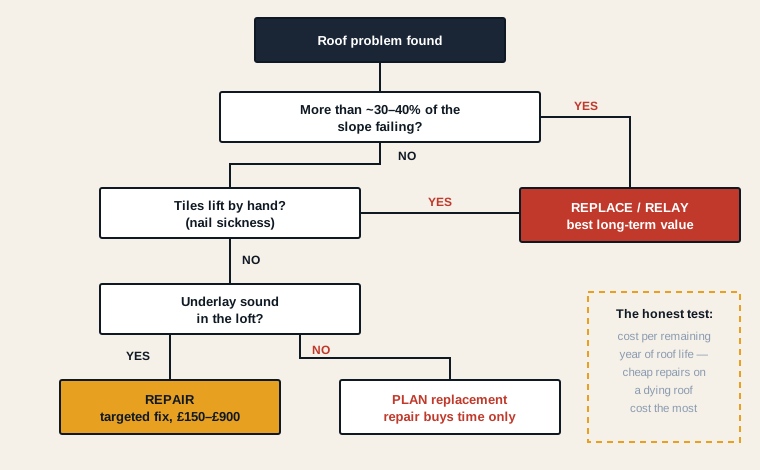
Most roofs should be repaired, not replaced — but there is a genuine tipping point, and knowing it protects you from both premature re-roofing and from patching a roof that is past saving. The decision turns on four things: how much of the covering has failed, the condition of the fixings, the state of the underlay, and the roof's age against its material life. The diagram below is the framework we use on every Guildford survey.
The single most useful rule of thumb: once more than roughly 30–40% of a slope has failed — multiple slipped or cracked tiles across the area, not one isolated spot — repairing tile-by-tile becomes money wasted. Each patch buys a little time, but you keep returning, and the cumulative cost overtakes a relay or replacement while leaving you with an ageing roof. Below that threshold, targeted repair is clearly the better value: a few tiles, a length of ridge, a lead valley, fixed and guaranteed for a fraction of a re-roof.
Cost-per-remaining-year is the honest measure. A £400 repair on a roof with 20 good years left costs £20 a year. The same £400 repeated every eighteen months on a roof that is failing across the board costs far more and delays the inevitable. When we survey, we estimate the covering's remaining life and set the repair cost against it — that ratio, more than any single price, tells you which way to go.
Park Barn, Stoughton, Bellfields, Westborough and Fairlands. The defining issue is nail sickness — corroded fixings letting tiles slip. On one slope, re-nailing is a repair; across several slopes reaching failure together, replacement or a full relay is the economical call. These roofs are now at the age where the decision genuinely tips.
Town-centre fringes and Merrow. Slate and clay have long lives, so the covering is often reusable — the failures are in ridge mortar, lead valleys and shared party-wall gutters, which repair well. A strip-and-relay refixes original slate rather than replacing it. Full replacement here is rarely the first answer.
Onslow Village fringe, Rydes Hill. Original clay peg tile often has life left, but the 1930s bitumen felt underlay beneath is usually well past its span. Here the decision is often a relay — reusing sound tiles on new membrane and battens — rather than either patch-repair or full new covering.
Being honest cuts both ways. A sound roof with isolated faults should be repaired, and a re-roof quoted on it is an oversell. The most common example in the Surrey market is the full ridge replacement — a homeowner told the whole ridge needs renewing when only the mortar has failed and a repoint at £250–£650 would do. Another is roof coating sold as an alternative to repair, which traps moisture and solves nothing. If a roof is under 25 years old, the underlay is sound in the loft, and the failures are localised, replacement is the wrong recommendation. We will tell you so, and quote the repair.
Equally, patching a roof that is genuinely failing across the board — to avoid a re-roof the property clearly needs — wastes your money and delays a job that will only get more expensive as water reaches the timbers. The right answer is specific to your roof, which is why the framework above ends at a free survey rather than a rule you apply blind. See our roof repair cost guide and new roof cost guide for the figures on each side, or read how to choose a roofer to spot an oversell.
Repair if damage is isolated and the roof is under about 25 years old with sound underlay and fixings. Replace if more than roughly a third of the covering has failed, nail sickness affects several slopes, or five-year repair costs approach half a re-roof. A survey settles it.
A rule of thumb: once more than about 30–40% of a slope has failed, repairing tile-by-tile costs more over time than relaying or replacing. Below that, targeted repair is usually the better value.
Concrete tile roofs on the post-war estates typically last 40–50 years; clay tile and natural slate 60+; flat felt 15–25 years. Wey Valley humidity trims these slightly. Age against material life is the key replace-or-repair signal.
Yes — replacing a roof with plenty of life left, or being sold a full re-ridge when only the mortar has failed, is a common oversell in Surrey. A sound roof with isolated faults should be repaired, not replaced.
If tiles lift by hand or slip after wind with no obvious breakage, the fixing nails have corroded — nail sickness. On one slope it can be re-nailed; across several slopes replacement is usually more economical. Common on Guildford's 1960s–70s concrete-tile estates.
Yes — an end-of-life roof is a deduction a surveyor flags, so a new roof with a transferable written guarantee typically returns close to its cost in the sale price and removes a negotiation lever from buyers.
That is the point of our free survey — we assess remaining life and give you the repair-versus-replace economics for your specific roof, and we recommend the cheaper repair just as readily as a re-roof when that is what the roof needs.
NFRC registered, fully insured, 10-year guarantee. Free survey across Guildford and Surrey. No call-out fee.
📅 Get My Free Quote📞 01483 346 440